

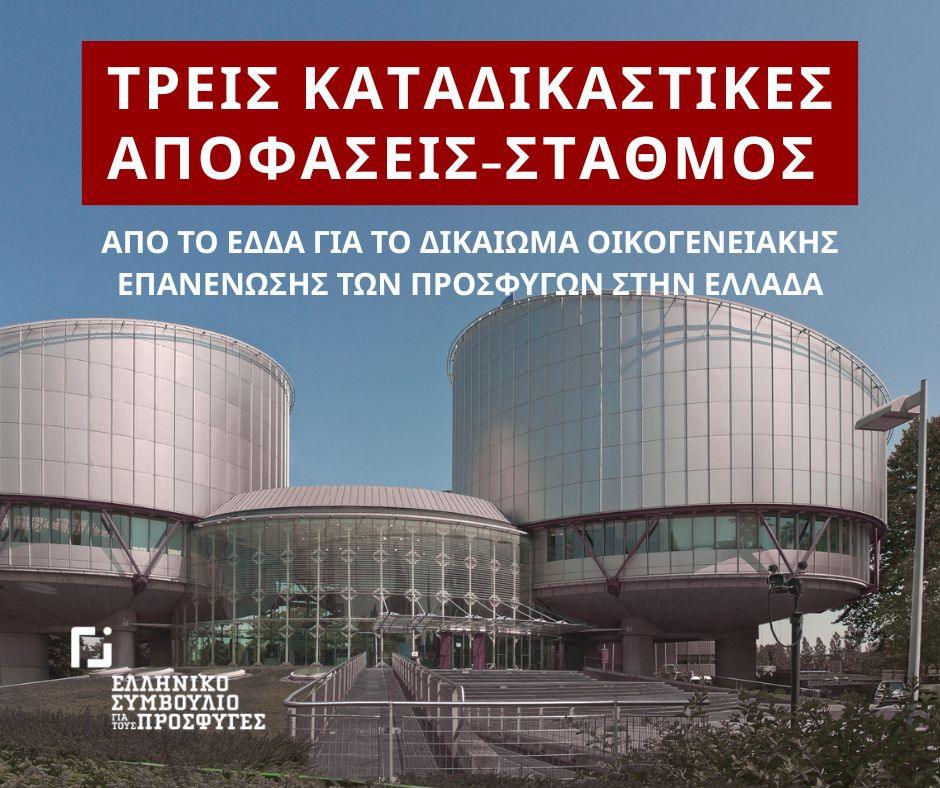
With three landmark judgments delivered on 23 June 2026, the European Court of Human Rights (ECtHR) has, for the first time, found violations of the right to respect for family life and the right to an effective remedy in cases concerning family reunification of recognised refugees in Greece.
In Dotani v. Greece (Application No. 31077/23), Suji v. Greece (Application No. 13250/23), and T.N. v. Greece (Application No. 41855/23) the Court examined the prolonged failure of the Greek authorities to decide on family reunification applications submitted by individuals who had been recognised as refugees in Greece but were objectively unable to provide the documents required under Greek law.
In all three cases, the applicants had applied for family reunification with their spouses and minor children. However, the Greek authorities failed to issue decisions within a reasonable time, insisting on the submission of documents that the applicants were objectively unable to obtain.
In the case of Dotani, the applicant, a recognised refugee from Afghanistan, was objectively unable to obtain documents certified by the Greek Consular Office in Islamabad, as the Consular Office refused to certify documents issued by the country's de facto governing authorities.
Dotani : "While we waited, I often felt as though I could not breathe. With this judgment, I finally felt that I had found my voice.”
In the case of Sujithe applicant, a recognised refugee and a stateless Rohingya from Myanmar, was unable to submit the required travel documents because his family members were themselves unable to obtain travel documents due to their statelessness.
Suji : «I feel vindicated. I am deeply moved and surprised by the judgment"
In the case of T.N.the applicant, a recognised refugee from Burundi, was objectively unable to provide the required travel documents for his family members, who are asylum seekers in South Africa.
T.N.: «I am grateful and, for the first time in many years, hopeful. I hope that one day I will be able to see my family again.”
The Court held that the Greek authorities had failed to ensure a procedure that was sufficiently flexible, effective and prompt for examining family reunification applications. In particular, it found that insufficient account had been taken of the objective difficulties faced by the applicants in proving their family relationships and obtaining travel documents. The Court further held that the Asylum Service, as the sole competent authority, should have explored alternative solutions.
In all three cases, the ECtHR unanimously found a violation of Article 8 of the European Convention on Human Rights, which guarantees the right to respect for family life, as well as a violation of Article 13 taken in conjunction with Article 8, holding that the applicants had not had access to an effective domestic remedy to challenge the prolonged administrative inaction.
These judgments make clear that the protection of family life requires States not only to establish family reunification procedures but also
to ensure that such procedures operate effectively, flexibly and without undue delay in practice. The examination of family reunification applications cannot be limited to a purely formal application of the legal requirements. The Greek authorities are required to assess the specific circumstances of each individual case and to take into account the practical obstacles recognised refugees face in proving their family relationships and securing the necessary travel documents.
The Court's findings are consistent with the conclusions of the recent report published by the Greek Council for Refugees, "Family Reunification of Recognised Refugees in Greece – July 2025,"which analyses the current legal framework and documents the main obstacles recognised refugees face in exercising their right to family reunification in practice.
The report is available here in english.
These judgments are expected to have a significant impact on the examination of family reunification applications in Greece, particularly in cases involving recognised refugees who are objectively unable to provide the supporting documents required under domestic law.
*All three applicants were legally represented by the Greek Council for Refugees (GCR) both before the national authorities and before the European Court of Human Rights. Third-party interventions before the ECtHR were submitted as follows: in Dotani v. Greece, by the United Nations High Commissioner for Refugees (UNHCR), The AIRE Centre (Advice on Individual Rights in Europe), the European Council on Refugees and Exiles (ECRE), and the Dutch Council for Refugees; in Suji v. Greece, by The AIRE Centre, ECRE, the Dutch Council for Refugees, and the European Network on Statelessness (ENS); and in T.N. v. Greece, by the International Refugee Assistance Project (IRAP) and Equal Rights Beyond Borders.
For further information: Konstantinos Vlachopoulos, Communications Officer, Greek Council for Refugees (GCR)k.vlachopoulos@gcr.gr

