

EU Pact on Migration and Asylum enters into force amid administrative paralysis, denial of access to asylum and prolonged de facto detention
On 12 June 2026, the EU Pact on Migration and Asylum officially entered into force across all Member States, following its adoption in May 2024. Despite having more than two years to prepare for its implementation, the Greek authorities failed to ensure the necessary administrative readiness. The launch of the new framework has been marked by severe dysfunction within the Asylum Service and other competent authorities. Asylum registrations have effectively come to a halt, leaving people who arrived after 12 June 2026 – as well as those whose applications were due to be registered after that date – unable to access the asylum procedure. As a result, asylum seekers are being exposed to prolonged de facto detention in Reception and Identification Service facilities on both the islands and the mainland, while many are denied reception conditions altogether. Others face the risk of criminal prosecution under legislation governing irregular stay, despite being objectively unable to lodge an asylum application through no fault of their own.
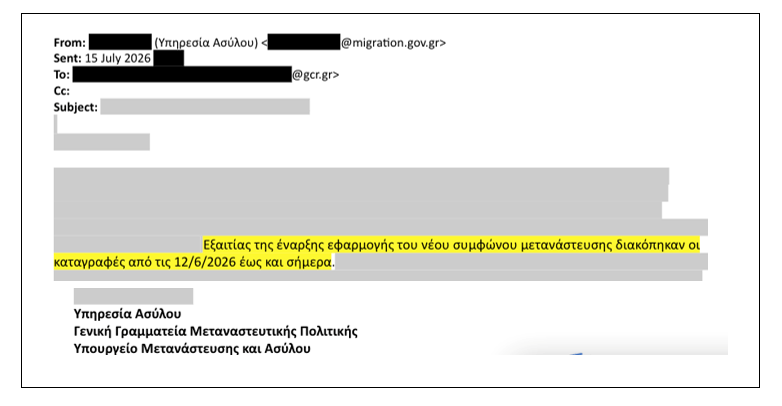
Cases documented across Greece include highly vulnerable individuals who have been denied access to asylum procedures, placed in detention, subjected to criminal prosecution, or left in conditions amounting to prolonged de facto detention.
GCR, Asylum Seekers Risk Imprisonment Due to the Asylum Service’s Failure to Register Asylum Applications[AK1] [MP2]
ERBB, Five weeks of implementation of the Common European Asylum System.
Επίσης
News24/7.gr, “Asylum Applications Put on Hold”, 8 July 2026
Efsyn.gr, Asylum: Greece Unprepared for the New Pact Procedures”, 10 July 2026
Child Protection in Decline: New Report by GCR and Save the Children
A new joint report by the Greek Council for Refugees (GCR) and Save the Children maps the challenges and the serious deterioration of child protection in Greece resulting from the national legislation adopted to implement the EU Pact on Migration and Asylum. Children on the move - Overview, April-June 2026.
Joint Ministerial Decision on Free Legal Counselling – GNCHR Calls for the Withdrawal of the Provisions
On 30 June 2026, after the implementation of the new Pact had already begun, a Joint Ministerial Decision (JMD) regulating the provision of free legal counselling under the Pact was published. The JMD links the level of lawyers’ remuneration to the voluntary departure of the third-country national receiving legal counselling. It further provides for the presence of authorised personnel from the Ministry of Migration and Asylum during legal counselling sessions for the purposes ""monitoring and evaluation"These provisions are, inter alia, wholly incompatible with the fundamental principles of the independence and impartiality of the legal profession, as enshrined in the Greek Lawyers’ Code and the Code of Conduct for Lawyers. The immediate withdrawal of these provisions was requested by the Greek National Commission for Human Rights (GNCHR). The Plenary of the Greek Bar Associations also announced that it would not participate in the provision of legal counselling (announcement) unless the Joint Ministerial Decision is amended before the establishment of the relevant Registry.
It should be recalled that the provision of legal counselling, together with the Independent Border Monitoring Mechanism, are perhaps the only provisions of the new Pact that introduce certain safeguards for asylum seekers within an overall framework characterised by excessive restrictions and the curtailment of rights. In Greece, however, both of these provisions have been implemented in a manner that significantly undermines their intended positive effect.
For further information on the Independent Border Monitoring Mechanism in Greece, see, inter alia:
Greek Ombudsman Observations on Article 39 of the Draft Law “Reform of Inheritance Law and Other Provisions”, 13 May 2026
GNCHR, "GNCHR before the Parliamentary Committee on the Ministry of Justice Draft Law", 14 May 2026
GCR, Comments on the Draft Law for the Implementation of the EU Pact on Migration and Asylum, 18 May 2026.
Reliable Data for the Evaluation of Asylum and Migration Policies
- Implementation of the “Return or Detention” Policy: Not Only Arbitrary, but Also Ineffective
- No Evidence Supports the Effectiveness of Detention: A 44% Increase in Detention Accompanied by a Decline in Returns in 2025
In recent months, sources within the Ministry of Migration and Asylum have referred to "significant Increase in Migrant Returns During the First Half of 2026" compared to"he same period in 2025.". According to sources by the Ministry, during the first half of 2026 alone, forced removals increased by 41%, while returns overall rose by 20% compared to the same period in 2025. This increase has been attributed by the Ministry to the successful implementation of the “prison or return” policy, namely the enforcement of legislation adopted in September 2025, which for the first time introduced into the Greek legal order the criminalisation of irregular stay. The legislation was adopted in violation of the principle of proportionality, EU law and fundamental safeguards under international law.
However, the reported increase in returns, as cited by sources within the Ministry of Migration and Asylum, is not reflected in the official data published by the Hellenic Police for the same period. On the contrary, the official figures record a 1% decrease in the overall number of returns. As a result, the purported success policy is not borne out by the available official data, regarding the"return or prison policy”.
The data demonstrate that the “return or prison” policy is not only contrary to the principle of proportionality, EU law and international law, but is also ineffective in achieving its stated objective.
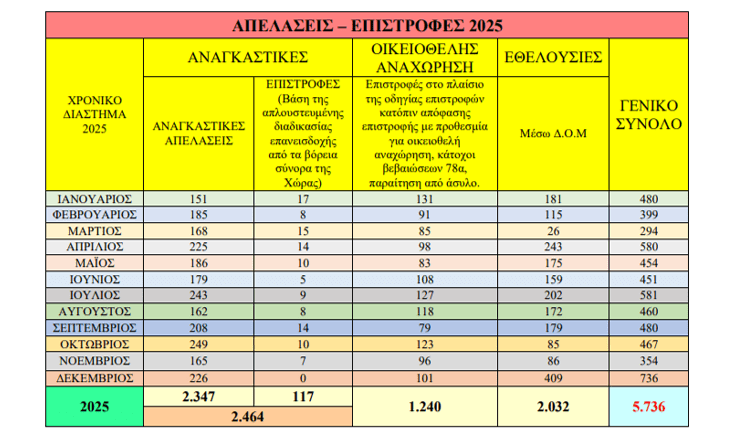
SOURCE: Hellenic Police statistical data, as provided to the Greek Council for Refugees (GCR) on 6 March 2026.
More specifically, according to data provided by the Hellenic Police, the number of persons subject to forced removals did indeed increase during the first half of 2026. However, this increase amounted to 11% (rather than the 40% claimed by sources within the Ministry of Migration and Asylum), corresponding to an absolute increase of 129 individuals.
However, when considering the total number of third-country nationals who returned during the first half of 2026—including forced returns, voluntary returns assisted by the International Organization for Migration (IOM), and self-organised departures—the overall figure was in fact 1% lower than during the corresponding period in 2025 (2,630 third-country nationals in 2026 compared with 2,658 in 2025), despite the new criminal legislation having been in force throughout the entire first half of 2026.
Detailed figures for the first half of 2025 and the first half of 2026
| Αναγκαστικές Απελάσεις/Επιστροφές | Εθελούσιες ΔΟΜ | Οικειοθελείς αναχωρήσεις | Συνολικός αριθμός επιστροφών/ αναχωρήσεων | |
| Α εξάμηνο 2025* | 1,163 | 899 | 596 | 2,658 |
| Α εξάμηνο 2026** | 1,292 | 870 | 468 | 2,630 |
| Διαφορά (%) 2025 (α’ εξάμηνο) : 2026 (α’ εξάμηνο) | Αύξηση 11.09 % – 129 άτομα περισσότερα | Μείωση 2.13 % – 29 άτομα λιγότερα | Μείωση 21.47 % – 128 άτομα λιγότερα | Μείωση 1.05% – 28 άτομα λιγότερα |
SOURCE: Hellenic Police data, as provided to the Greek Council for Refugees (GCR) on 6 March 2026.
**SOURCE: Sources within the Ministry of Migration and Asylum. LINK
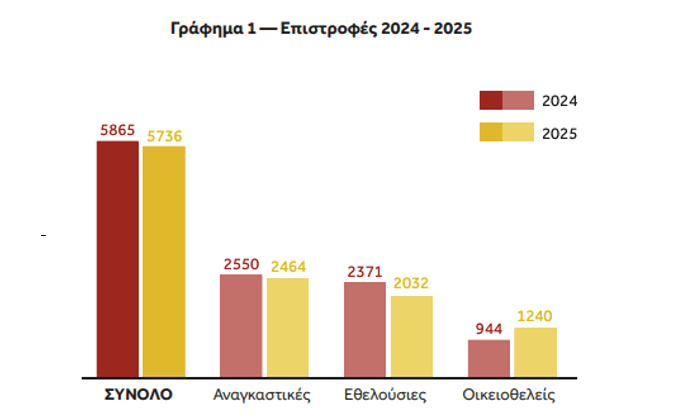
These figures should also be considered in light of the findings presented in the recent report of the Greek Ombudsman, issued in the exercise of its mandate as the National Mechanism for the External Monitoring of Forced Returns (Annual Report | Returns of Foreign Nationals 2025). The report likewise confirms that the implementation of stricter detention policies affecting a larger number of people is not associated with an increase in returns. While the number of third-country nationals placed in administrative detention increased by 44% in 2025 (full year) compared with the previous year (2024), the overall number of returns decreased by 2% over the same period.
–
SOURCE: Greek Ombudsman, Annual Report | Returns of Foreign Nationals 2025, page 21
SOURCE: Greek Ombudsman, Annual Report | Returns of Foreign Nationals 2025, page 24
Recommendations by the European Ombudsman to the European Union Agency for Asylum (EUAA) on the Handling of Asylum Cases in Greece
On 6 July 2026, the European Ombudsman published her recommendations to the European Union Agency for Asylum (EUAA). The case concerns the manner in which the Agency addressed allegations of fundamental rights violations in the context of its activities on the Greek island of Samos.
The European Ombudsman found that:
- At the time the complaint was lodged, the EUAA had not ensured that case officers deployed to asylum support teams were adequately prepared to conduct interviews with vulnerable asylum applicants. This included, among other things, a failure to ensure that they were properly equipped to identify and take into account indicators of vulnerability when such indicators emerged for the first time during the asylum interview.
- The EUAA did not provide vulnerable asylum applicants with an adequate mechanism for reporting errors that occurred during asylum interviews, nor had it ensured that such reports would be reviewed by the Agency itself and
- The Ombudsman also identified significant shortcomings in the manner in which the EUAA handled asylum applicants’ reports of pushbacks made during asylum interviews.
See more: Full text of the European Ombudsman’s inquiry and recommendations in case 229/2024/AML
Annual Report of the Recording Mechanism of Informal Forced Returns - 2025
The new 2025 Annual Report of the Recording Mechanism for Informal Forced Returns, established by the Greek National Commission for Human Rights (GNCHR), documents at least 359 individuals alleged to have been subjected to informal forced returns, including at least 94 women, 90 children and 42 persons with specific vulnerabilities. The findings of the Report once again confirm the widespread and systematic nature of this practice, a reality that has already been underscored by the European Court of Human Rights in its landmark judgment in the case of A.R.E. v. Greece.
Greek Asylum Case Law Report | Issue 1/2026
Δημοσιεύθηκε το Τεύχος 1/2026 Issue 1/2026 of the Asylum Case Law Report has been published, featuring extracts from 60 decisions issued during the first half of 2026 by administrative, civil and criminal courts, the Independent Appeals Committees, and the Asylum Service.
Issue 1/2026 of the Asylum Case Law Report
[AK1]Add link
[MP2]https://gcr.gr/el/news/item/aitoyntes-asylo-kindyneyoyn-na-odigithoyn-sti-fylaki-logo-tis-adynamias-tis-ypiresias-asyloy-na-katagrapsei-aitimata-asyloy/

